
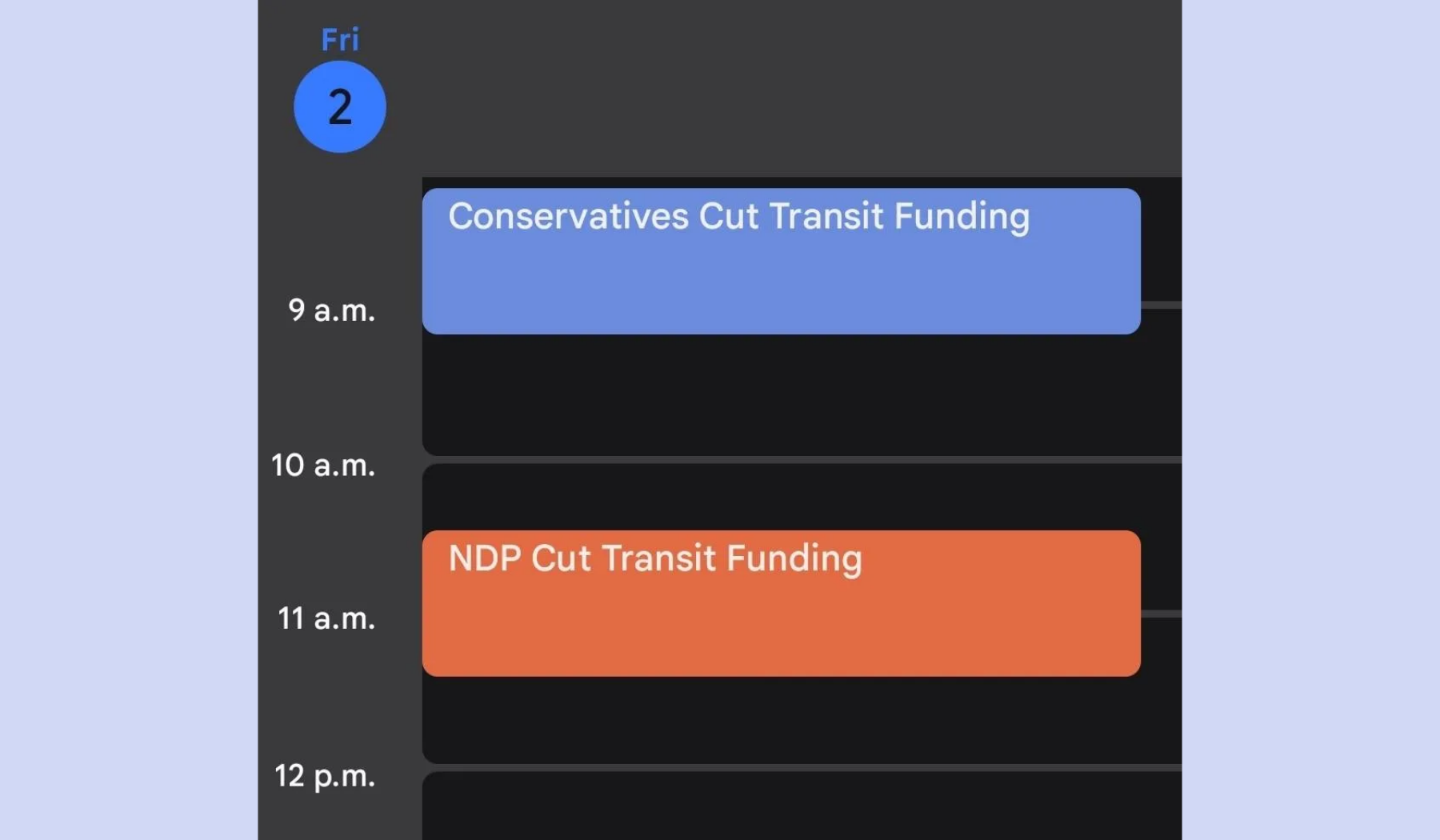
2 hours and 13 minutes. That’s how long it took David Eby to capitulate on TransLink’s new revenue tool, putting Metro Vancouver’s transit system at risk in a political race where parties compete to see who can cut the most taxes.
It was reported by Jas Johal (CKNW) at 8:13 AM that the provincial government and TransLink had been in discussion about that new revenue tool being an annual charge levied on Metro Vancouver drivers; by 10:26 AM that plan was announced cancelled by David Eby. Perhaps in an act of sardonic celebration, the choice by Eby marks the 25th Anniversary of his Minister of Transportation & Transit Mike Farnworth first cancelling a planned vehicle levy for TransLink in 2001 ahead of the election they proceeded to lose 77-2 (from 39-33). The BC NDP has now been breaking promises on this file for a quarter-century, with skeletons in the closet to show for it.
In an election that has exclusively centered on affordability and economic resilience (and Donald Trump), defunding public transit is a brainless strategy. It means removing the ability to service people with the most affordable form of transportation. Instead, public transit funding is, again, a casualty in a competition between parties seeing who can best slash taxes in the name of addressing affordability, even if that comes at the expense of cost-saving services. Maybe cuts to provincially funded childcare programs are next in the queue – axing that social service would “save” people the cost of childcare .
The vehicle levy was purported to be $100-150 annually, likely scaled by vehicle weight or value to make the levy progressive, meaning it would likely cost even less for those driving inexpensive cars. Many vehicle owners spend that amount regularly on one tank of gas. Drivers with electric vehicles already save much, much more not needing to pay for gasoline than they would pay through this levy. Instead, by removing the promise of such a revenue source, prospective parties are putting worsened gridlock and increased transportation expenses in their platforms.
Providing people with the ability to use transit instead of requiring an expensive personal vehicle means saving thousands of dollars per year. Providing people with more transit service means giving them the dignity of not having to schedule their lives around a once-hourly bus, waiting in the rain for a bus that doesn’t show up, or even having to say ‘no’ to job opportunities because they can’t afford the commute. Essential service workers will be shut out from transit altogether when service spans are cut. These time and cost savings – or barriers to opportunity – are very real, but are most often not capitalized on by campaigning political parties because actual communication skills would be required to convey such a message.
In a perfect world, at least one party would show up to this public transit debate with a brain and a spine. Instead, the 1,000,000 people making up the public transit-using electorate in Metro Vancouver are left wondering what the state of the transit system will be when a new government is formed on October 24.

Leave a Reply