
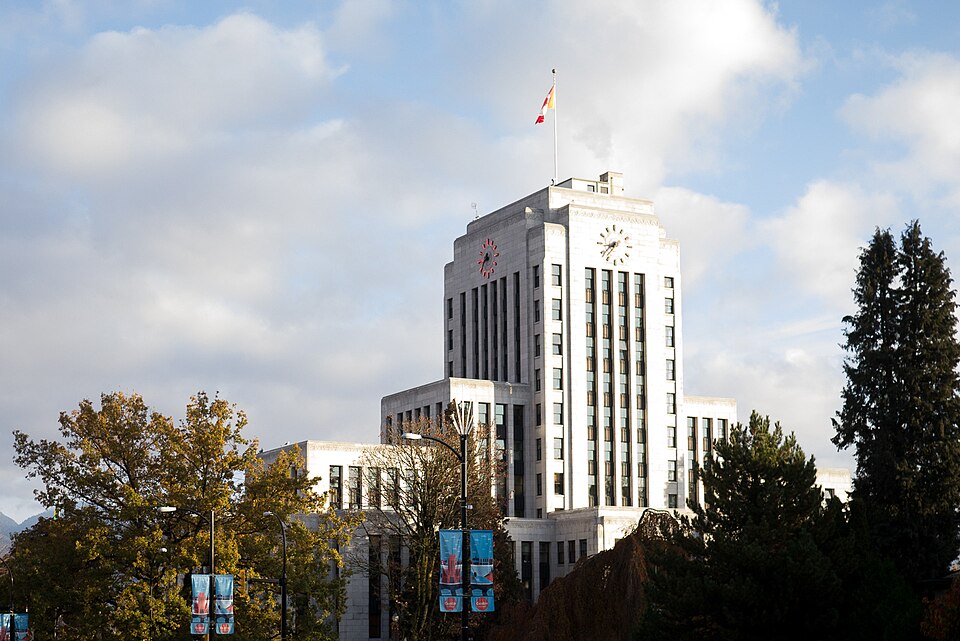
The City of Vancouver is taking ABC Councillor Lenny Zhou (周楠) and OneCity candidates Iona Bonamis (陶思颖) and Christopher Lee (李基鹏) to court to deny them the right to use their Chinese names on the ballot.
Under section 44 of the Vancouver Charter, candidates are entitled to appear under “the usual name of the person nominated, if the full name of the person is different from the name the person usually uses and the person wishes to have the person’s usual name on the ballot instead.” To dispute that a Chinese person’s Chinese name that they were given at birth is their usual name is not only indefensible—it is tinged with the stench of racism.
First, the city is plainly applying a double standard that subjects racialized candidates to a more exacting level of scrutiny compared to non-racialized candidates. A cursory review of recent ballots shows that the city’s electoral officer routinely registers a number of nonsensical nicknames at elections, including “Watermelon” at the 2017 by-election, “Mrs. Doubtfire” at the 2018 election, “Evil Genius” at the 2022 election, and of course “Rollergirl” at every election since time immemorial. Over in Burnaby, the city clerk had no issue last week accepting the registration of a certain “MichaelAngelo A_BC RobinHood” despite applying the exact same legal rule as Vancouver (section 87 of the Local Government Act, which governs Burnaby elections, is virtually identical in substance to the Vancouver Charter).
To accept attention-seeking monikers made up from wholecloth by perennial candidates and then turn around and refuse to acknowledge the names that racialized people are given by their parents at birth is an outrage for a city that purports to be committed to diversity and multiculturalism.
The chief electoral officer’s paper-thin rationale to refuse Lenny, Iona and Christopher’s usual names would be comical were it not wildly offensive. According to the Vancouver Sun, city attorney Grant Murray argued in provincial court that Lenny Zhou’s Chinese name could not be his usual name because “[a]ll of the correspondence with the electoral office is signed Lenny [and] not the name in Chinese characters.” That an immigrant would use an English form of their name when signing legal documents intended to be read by English speakers says absolutely nothing about whether they usually use a non-English name. First-generation immigrants are often forced to compromise on their cultural identity to better assimilate into Canadian society; this should not come at the expense of the right to use their birth name in public life if and when they so choose.
More fundamentally, the city’s conflation of a usual name with the name that most commonly appears in English media betrays a cultural chauvinism that says nothing about the candidates themselves and everything about the election office’s parochial worldview.
Vancouver is not a monolingual city, and the usual name of a candidate with deep ties to an immigrant community will not necessarily be in English. Per the 2021 Census, 49% of all Vancouver residents did not have English as a mother tongue. Fully 147,000 Vancouverites—23% of the city’s population—profess knowledge of Mandarin or Cantonese. For the city to look solely at English social media ignores that there exists an entire, vibrant parallel ecosystem of non-English civil society in Vancouver. Even a cursory look at this ecosystem would reveal a litany of articles that refer to Councillor Zhou as 周楠 and to Iona Bonamis as 陶思颖.
To be clear, there is not—and has never been—a requirement that a candidate’s usual name be in English. The word English never appears in the Vancouver Charter (except in the set phrase “English Bay”), the Community Charter or the Local Government Act. Neither the Interpretation Act nor the provincial Constitution Act direct the government to treat English as the official language of British Columbia.
Indeed, one is left to wonder how the chief electoral officer’s ruling is consistent with the Human Rights Code and the Canadian Charter of Rights and Freedoms, which prohibit the City from discriminating on the basis of race and national origin. I would argue that a ballot naming policy that disparately affects racialized candidates who seek to use names associated with a particular race and national origin is, constructively, racial discrimination against that group.
In the short term, we can only hope that a provincial judge sees the common sense that the city’s own officials failed to see in interpreting Vancouver’s election rules. But in the long term, we need meaningful accountability. This is the third election in a row, after 2018 and 2022, that the city elections office is attempting to enforce its offensive ballot naming rule. The next council must settle this debate once and for all and order the elections office to cease enforcement of its policy.

Leave a Reply