
Sam Holland is the Chair of Better Transit YYJ
In 1978, British Columbia had a robust public intercity bus network, two publicly owned intercity rail operators, robust and rapidly growing urban transit, and a brand new public ferry company. Nearly fifty years later, BC has effectively no functional public intercity transit, increasingly unreliable ferries, and functional but stagnant urban transit outside of Metro Vancouver.
We clearly have bigger issues than funding. When the Province builds new transit infrastructure, the projects are double, triple, even an order of magnitude too expensive (compared to projects we’ve done before and to other jurisdictions); they are often over budget and significantly delayed. These are common symptoms of public services with inadequate public procurement practices and inexperienced institutions.
On top of institutional experience, even when regions across BC want to spend more money on transit, they are legally or conventionally prevented. One repeating pattern in BC history caused all of these issues with transit — every time BC faced big deficits after 1975, the Province responded by controlling costs by cutting back on public transit. In other words, BC has repeatedly chosen to avoid growing public transit.
The second reason behind transit not keeping up is the continued subsidization of highways. This takes a few forms. The most obvious is the direct subsidization of operations and maintenance (which has consistently remained at about double that of subsidies for BC Transit).
Less obvious is the transfer of debt to Crown corporations. Currently and historically, BC Ferries, BC Hydro, BC Rail, and BC Transit all carry their own debt burdens from capital projects and purchases, and must self-fund to pay down debt. While historically many road projects were paid for by tolls, all major highway debt is paid via grants or is folded into the provincial debt. This acts as a second layer of subsidy for roadways.
Fundamentally, the shrunken capacity of our transit institutions is the product of these decisions.
First, let’s take a look at how our transit institutions got their start and how BC has funded them along the way. Secondly, let’s look at the impact of privatization and austerity in the 70s, and 80s. Thirdly, we can look at the budget crisis of the 90s and the subsequent creation of TransLink. Finally, we can take a look at the system as it stands today.
“Wacky Bennett”
One party, the BC Social Credit Party, made nearly all of the most consequential creative decisions for transit more than forty years ago. The “Socreds” no longer exist, despite the fact that they dominated provincial politics from 1952 to 1991.
Almost every public transportation institution in the province started out private, and was made public by Social Credit governments. The “Socreds” started as a populist conservative party that evolved into fiscal conservatism in the 70s, with consistent support from federal Liberal and Conservative voters.

The populist Socred era (the so-called “Wacky Bennett” era under Premier W. A. C. Bennett) produced large provincial institutions designed to deliver megaprojects, facilitate resource extraction, and develop the province. These institutions and major projects are fundamental to the BC we live in.
In their first 20 years, the Socreds nationalized BC Hydro through a forced buyout, created BC Ferries as an extension of the highway system, and built an enormous number of railways, highway, and dams. The Socreds also established the second and third provincial universities (University of Victoria and Simon Fraser University) and introduced universal publicly-funded healthcare insurance.
BC Hydro might not seem like an obvious thing to discuss in the context of transit. The nationalization certainly didn’t have anything to do with transit—W.A.C Bennett nationalized BC Hydro because he wanted to control the Columbia River Treaty negotiations and use them as an opportunity to get money for dam development on the Peace River.
Nationalizing BC Hydro had the side effect of creating a province-owned public transit network, with the vast majority of the service in Victoria and Vancouver. BC Hydro (previously BC Electric and the BC Power Commission) owned streetcar and interurban rail lines, as well as the newer urban and intercity bus services, mainly focussed around the Lower Mainland and the South Island.
Rather than invest and grow transit, W.A.C Bennett kept transit under the umbrella of BC Hydro, where hydro rates subsidized services. This avoided touching the political consensus around BC’s power monopoly—so long as BC Electric provided decent public services, they could continue operating.
Conversely, we can best see the creation of BC Ferries as populist policy, a populist maneuver to break the power that Canada Pacific Railway and Black Ball had over ferry routes. Bennett wanted to create an extension of the highway system, and you can still find older maps that refer to the “marine highway” of BC Ferries routes.
The rapid expansion into ferries was reflective of a broader, massive investment into highway and rail infrastructure. Initially, the Socreds funded highway expansion through tolls, but industrial development and the Trans-Canada Highways act allowed them to pursue an incredible amount of toll-free highway construction in the 1960s.
The 1960s BC Ferries was able to take advantage of a robust local shipbuilding industry in procurement. All they had to do was point at the MV Coho, operated by the Black Ball Ferry Line, and say "like that one, please."

The Socreds grew BC Ferries quite quickly, aggressively purchasing ships from Canadian Pacific and Black Ball, as their new provincially subsidized ferry line drove their private services out of business.

While BC Ferries expansions into the 80s provided some business to local shipyards, the province had no coordinated or sustained strategy to keep local shipbuilding capacity, such as through coordinated modernization programs or organizing long-term supply contracts. This absence laid the groundwork for the difficulties of the 90s, and is partly why BC now has to depend on Polish, Romanian, and Chinese shipyards to procure new ferries.
The Socreds also invested heavily into BC Rail, building long rail lines into rural and northern corners of the province and establishing the first true north-south rail link from the North Shore to Prince George. While they pushed BC Rail to focus on freight, especially as highways became more central to their vision of governing BC, BC Rail was still an important part of the transportation network, with links to Prince George and Whistler.
This populist Socred era was an era in which the BC government did a lot of big things. While a lot of these projects explicitly served resource extraction and opened up the province to further settlement, they created a government with a history and an ability to build projects. The W.A.C era also created a government with a large number of publicly run services: BC Rail, BC Hydro, and BC Ferries.
The massive expansion of BC infrastructure in the 1950s and 60s caused runaway public services costs, boosted even further by high birth rates and migration. Public transit was no exception; BC Hydro couldn’t keep up with the costs of maintaining both enormous dams and an urban public transit system while keeping hydro dues low.
To cope with this issue, the Socreds chose to support the transit system rather than cut back. They pledged to pay up to half of the operating deficit for all loss-making non-profit transit systems. This change announced a major shift in provincial transit policy that the NDP took to an even bigger level.
Optimism: Barrett the First
W.A.C’s time in power ended with a surprise to everyone, except perhaps the NDP, who had won after almost thirty years of being the official opposition. Barrett only lasted for three short years, but managed to create an inordinate number of institutions (ICBC, Pharmacare, the Agricultural Land Reserve, an Office for the Status of Women) as well as massive investments in housing and transit.
Barrett’s administration marked a turning point in BC Transit history (not just because they ordered a bunch of new busses and painted everything orange). The NDP created the first provincial office responsible for transit planning, the Bureau of Transit Services, paid for by a new gas tax. Additionally, they launched a railway study for Metro Vancouver that nixed an additional highway crossing in favour of what became the SeaBus.

While Barrett’s administration was enormously productive, passing an average of one law every three days, they did not have the time to fully deal with BC Hydro. Still, they took the 50% subsidy and the gas tax created by W.A.C Bennett’s administration and created the beginnings of a new institution. The provincial government was now fully in the business of transit.
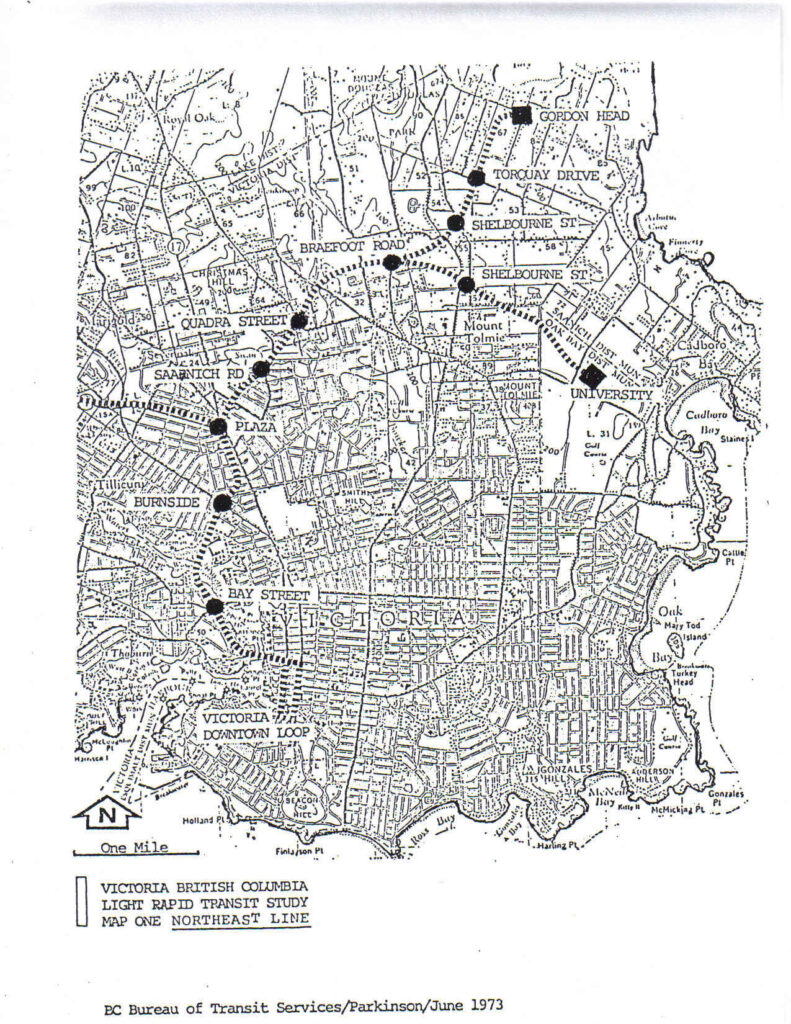
Barrett’s government didn’t last long, and the Socreds were back in power by 1975, this time led by W.A.C. Bennett’s son, Bill Bennett.
The First Reckoning: Bennett the Second
The oil shock and global economic slowdown of 1975 set the stage for the first real efforts to tackle a modern structural deficit in BC. Successive Social Credit governments slimmed down and cut away institutional funding from institutions that in many cases their own party created a decade earlier.
To start, Bill Bennett’s government tackled provincial Crown corporations, where his father had stashed unsustainable debts to pay for major infrastructure projects. They slimmed down support for BC Rail and split off public transit from BC Hydro. This ripped away the subsidy provided by hydro rates (except for a small hydro fee in Metro Vancouver).
To find new revenue, the Socreds increased the provincial sales tax to 7%, increased taxes on logging, implemented a head tax for healthcare (the Medical Services Premium), and implemented steep “sin” taxes on tobacco and alcohol. BC Hydro, BC Ferries and BC Rail raised rates and fares (BC Hydro raised transit fares by 40% in one year, from 25¢ to 35¢ ($1 to $1.40 in 2026 dollars). These rates and fares kept going up throughout the 70s and 80s.
BC Ferries was the hardest hit. Bill Bennett’s government broke BC Ferries out from the highway system as a separate crown corporation in 1977 and doubled fares on most routes overnight (although this didn’t last). The Socreds also further reduced provincial subsidies by obtaining a federal subsidy for BC Ferries, arguing it was part of the Trans-Canada Highway.
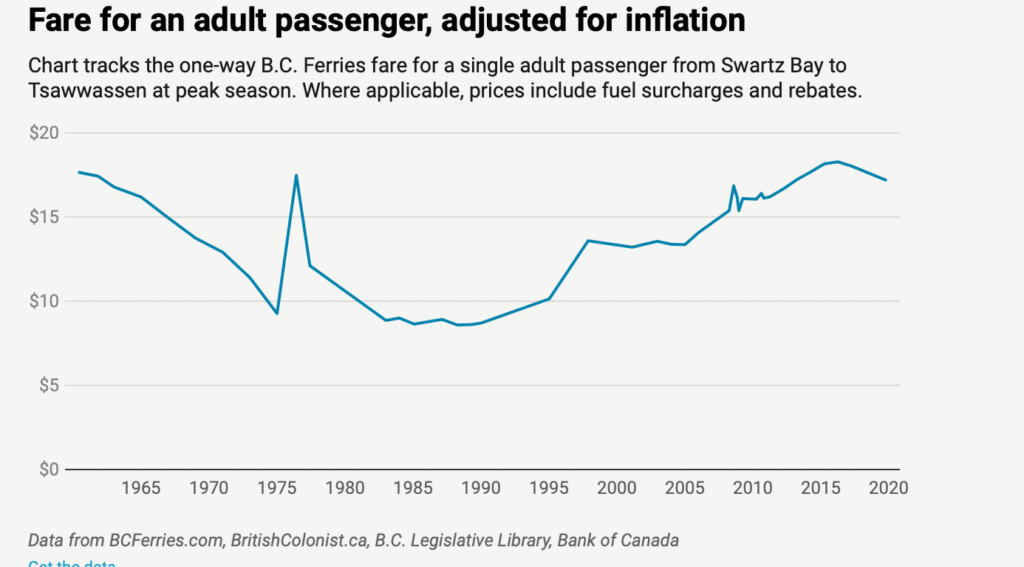
With a new mandate for increased financial independence, BC Ferries had to keep increasing fares. Breaking BC Ferries out as a separate organization also meant Bill Bennett could saddle it with debt. Rather than pay for new ferries through direct capital investments, the Socreds transitioned to passing many of the costs for fleet expansion onto farepayers.
Bennett’s government divided BC Hydro transit into the Urban Transit Authority (now called BC Transit) and Pacific Coach Lines, an organization that inherited all of BC Hydro’s intercity routes. The goal was to control costs and keep the provincial power utility sustainable.
To start, Bill Bennett’s government went after the provincial Crown corporations, where his father had stashed enormous debts to pay for major infrastructure projects, particularly BC Rail and BC Hydro.
They slimmed down support for BC Ferries and passenger rail, and split off public transit from BC Hydro. This ripped away the subsidy provided by hydro rates (except for a small hydro fee in Metro Vancouver).
20th Century Transit Institutions
| Use Case | Institution(s) | Funding model (WAC Bennett) | Funding model ( Bill Bennett) | Impact of privatization wave |
| Intercity transit (road) | Pacific Coach Lines (1978-1988) | BC Hydro subsidized service. | Province supported public service with capital funding. Profitable routes and freight were supposed to cover loss-making routes. | Privatized |
| Urban Transit | BC Transit, aka Urban Transit Authority (1979- present) | BC Hydro subsidized public service in Vancouver and Victoria. | Province supported with capital funding and substantial subsidy. Set provincial/local funding share of 47/53% and 31/69% of cost minus fare revenue from 1990s onwards. | Shifted to contracting out many operations, fare increases, municipal contribution increases, reduced service in many areas |
| Intercity transit (rail) | BC Rail | Passenger service generally profitable. | Province supported with capital funding. Freight operations covered losses from passenger service. | Assets sold or leased to CN (see: BC Rail scandal) |
| Mainline rail (Federal) | Canadian National Railway/ Canadian Pacific Railway | Passenger service generally profitable. | CN: National crown corp with federal subsidies and capital funding CP: private | Privatized |
| Mainline Rail (Provincial) | Via Rail | n/a | Direct federal subsidies to make up operating shortfalls. | Systematic route reduction with coverage reduced about half |
| Ferries | BC Ferries | Part of the highway system, supported by bridge and highway tolls, fuel taxes, general revenue. | Targeted subsidies and capital support, expectation of cross subsidy from profitable routes and freight. | Privatized but still owned and controlled by province outside of interior. Subsidies greatly reduced, ticket prices increased about 2x for passengers and 3x for drivers (inflation adjusted) from 1970s to present. |
| Highways | BC Ministry of Highways | Paid for from general revenues, as well as gas tax. | Tolls for specific projects, gas tax, general revenue | Little impact |
The goal for the 1978 and 1979 creations of Pacific Coach Lines and BC Transit was better governance and cost control, as well as to save BC Hydro. The BC Transit model also quickly showed the advantages of centralization for building large infrastructure projects, with the development of the Expo Line. Still, the general goal of BC Transit was not to massively expand transit— it was a cost control measure and its new funding structure reflected that.
The Socreds gave BC Transit a codified funding split between provincial and local operational funding. This created a very transparent system where the Province controlled exactly how much money was spent on public transit, and where. The Socreds effectively forced local government to get into the business of paying for transit.
While this system created very stable transit funding, It also meant growth was dependent on total agreement between the Province and local partners. The exact funding split has varied somewhat, but generally it has settled towards ~30% provincial funding for Victoria and Vancouver and ~50% for everywhere else (with a separate ratio for HandiDart services, called “custom transit”).
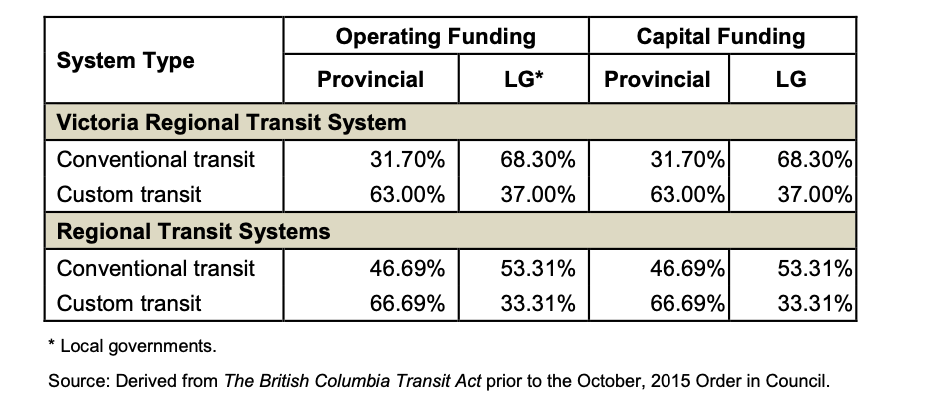
The Provincial share came out of general revenue, and the local share came from a mixture of fares, property taxes, gas taxes, and (for Vancouver) hydro rates.
The transition from subsidizing transit through hydro power rates meant that transit funding was now dependent on political decision-making.This was a tradeoff that allowed expansion and growth as demanded by political necessity, but it meant local and provincial governments needed to figure out how to pay for it.
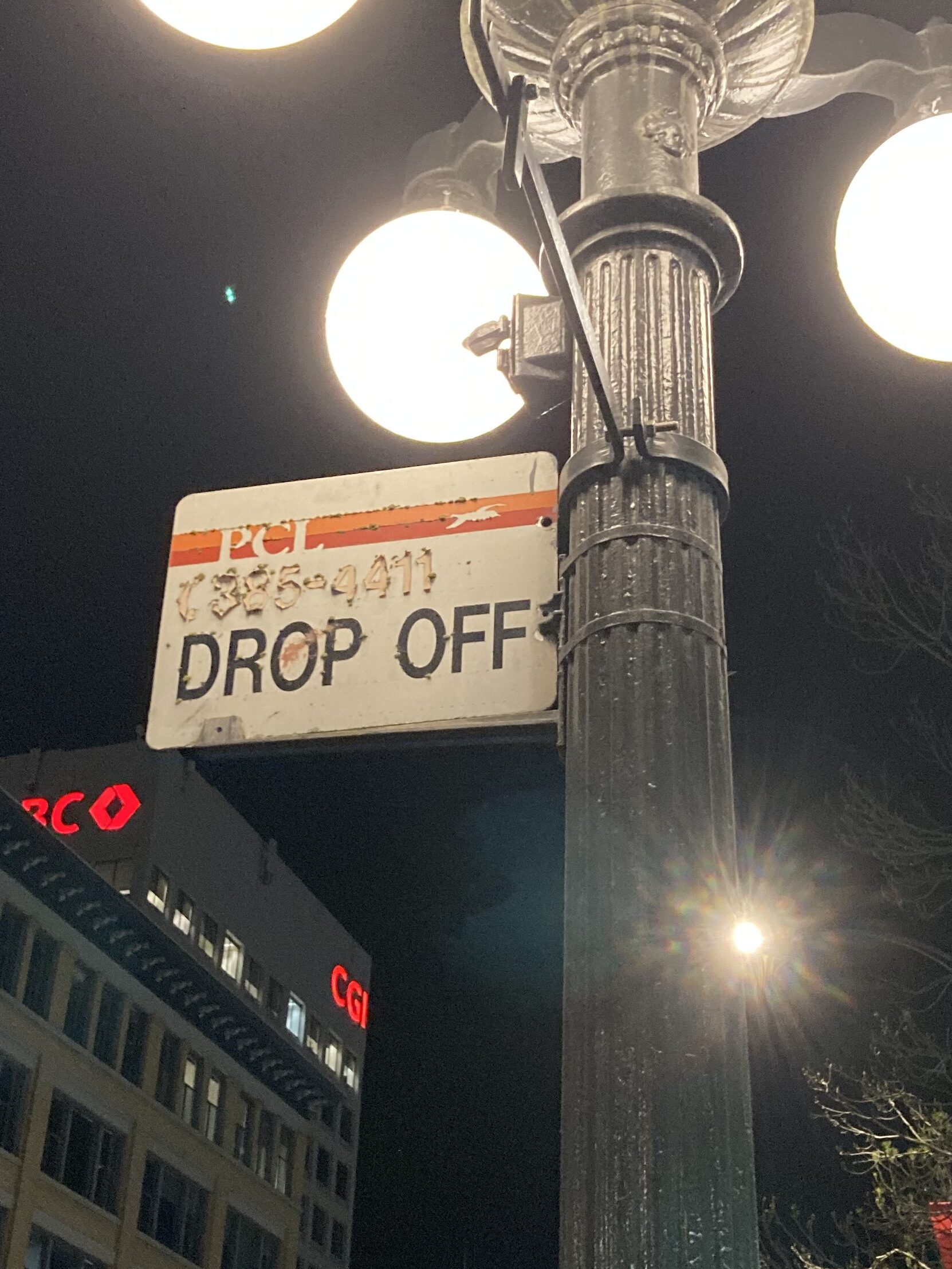
The Socred’s original vision for Pacific Coach Lines was that it would survive on fare revenues alone, but this proved unrealistic. PCL was soon privatized and left to run a few profitable routes. This was the last time that a dedicated BC Crown was responsible for operating and planning intercity bus service.
Still, on transit, Bill Bennett’s administration sustained or grew government capacity for transit.
Bill Bennett’s election is when government capacity for megaprojects started to wane. Starting in the 1980s, BC Hydro transitioned to buying power from private producers rather than completing their own megaprojects. His administration built few highway projects compared to his father’s, and only one major rail project, the Tumbler Ridge Subdivision (an unprofitable and expensive freight line).

A long Wikipedia list of bridges and highways completed in the ‘60s and ‘70s is followed by only the Coquihalla Highway and the Alex Fraser. Notably, the Coquihalla was harshly criticized by future audits and administrations for failing to follow good project management and procurement practices.

It's also important to point out what the Socreds did NOT do; the party did not move to a cost-recovery structure for highways. This established a significant structural barrier for transit. Even as half or more of the costs for transit were downloaded to local governments, highways were  fully subsidized and free at point of use.

The reluctance to do cost recovery for motorists also meant that the province lost the political moment to give transit a scalable revenue tool to subsidize operations.
The creation of a centralized provincial bureaucracy for transit, along with Expo 86, the development of regional transit planning, and the prospect of reducing operational costs by automating a prospective SkyTrain were enough to produce several large investments into BC’s only metro system. This allowed BC Transit, and later TransLink, to build the institutional capacity and memory to successfully manage large infrastructure projects, at least into the 2000s.
The Socreds did not provide increases to transit funding as a matched set with the SkyTrain. Through the 80s and 90s, slow investment in transit drove Vancouver residents to frustration, especially as new residents flocked to booming suburbs like Surrey. The funding split meant that both the province and local governments needed to agree to expand service, and the Socreds were not fond of rapidly increasing public costs.
The second Bennett’s administration’s transit legacy is mixed. On the one hand, they created BC Transit and grew it into an organization able to successfully deliver major infrastructure projects and manage transit across the entire province, including Metro Vancouver. However, they created a system entirely dependent on political support for both operational and capital funding.
In terms of overall Provincial capacity, the cutback on projects severely limited the province's ability to deliver things on-time and under budget. No new major dam was completed in BC until Site C in 2025, a project that went more than double over budget and took years longer than expected. Bill Bennett's administration also oversaw the last major fleet expansions for BC Ferries in the 80s. Did the NDP break transit? (only a little)
By the 1990s the Socreds had run BC continuously since the 1950s, with a 3 year break in the 70s of the Barrett administration. The collapse of the Socreds in 1991 in favour of NDP governments led to one major change— the creation of TransLink. This process revealed some big cracks in the transit funding system: the provincial split doesn’t scale well, the split prevents transit investment from growing rapidly, and public intercity transit has no clear pathway forward.
As mentioned earlier, Vancouver transit wasn’t keeping up with population growth. BC Transit ran Metro Vancouver’s via the Vancouver Regional Transit Commission since the 1980s.. That meant Metro Vancouver benefitted from the local/provincial operational funding split (which still exists in the rest of the province). The Province covered 31% of operational costs and the regional Transit Commission covered the rest. More than half of the Transit Commission’s share came from fares, and the rest came from fuel taxes, non-residential property taxes, and hydro fees.
That 31% split is what prevented Metro Vancouver from investing more in transit. In the 90s, the transit commission even sought a specific exemption to fund the 99 B-line. This frustrated local leaders who wanted more and better transit. The solution they identified was a new and separate institution, a regional transit authority. Today, we call that institution TransLink.
The 31% split had an additional issue— the 70% share paid by Vancouver governments included fares. That meant that even as fare revenue increased to well over a third of total operating costs, the provincial share continued to grow, even as municipal costs plateaued. In fact, due to the dominance of fares in the local share, Vancouver didn’t even need to tax residential properties to subsidize transit.
The operational subsidy from the Province was tough for the Harcourt government to justify. The 1990s federal government retreat from funding schooling, income assistance, and healthcare blew an additional billion dollar hole in the Provincial deficit. TransLink’s creation opened an opportunity to lower Provincial costs.
Had there been less financial pressure on the Province (and if BC wasn’t allergic to property tax increases), there would probably have been more gentle ways to wean Vancouver off of provincial subsidies. Instead, TransLink’s creation revolved around abandoning the operational subsidy from the Province and replacing the revenue from three sources: higher fuel taxes, transferring SkyTrain debt to the province, and a proposed suite of taxation powers, including vehicle charges and parking taxes.
TransLink needed some form of vehicle charge because they took on the costs of congestion and road expansion (road maintenance and lost transit ridership) and needed a tool to recoup these costs. The catch was that TransLink couldn’t unilaterally impose most of these new taxes. They needed permission from the Province.
Unfortunately for TransLink, they wouldn’t get that permission to balance their books with a vehicle levy. The timing was poor. Just months before the 2001 election and with the NDP trailing in the polls due to the “Fudge it Budget” and the Fast Ferries Scandal, then- Minister responsible for TransLink Mike Farnsworth (the current Minister of Transit) refused to implement the levy.

With the Liberals also promising no new fees without a referendum, TransLink implemented a huge cut to Vancouver transit service. At the time the fee would have amounted to about $10 a month for car owners, or about $120 a year. The lack of sustainable funding has repeatedly forced TransLink to delay expansion or seek help from the Province to cover deficits. It’s also created a continuous tension between two political considerations: the need to fund transit, and the need to keep property taxpayers happy.
One big reason the NDP lost the 2001 election was the “Fast Ferries Scandal” BC Ferries needed a new fleet, and the NDP took it as an opportunity to rebuild the decayed shipbuilding industry in BC. They ordered a series of "FastCat" ferries designed to speed up travel and dramatically increase frequency between Victoria and Vancouver.

This looked like a good idea, but the project quickly got bogged down. While BC Ferries had been continuously purchasing ferries from local shipyards, the Province had not attended to overall capacity, competitiveness, and innovation in the BC shipbuilding sector. In particular, BC shipyards were mostly familiar with steel hull construction, instead of more modern aluminum hulls.

The FastCats were a completely new design that proved quite complex, and used aluminum hulls rather than steel. Local shipyards were unused to building such complex projects and had very little experience with aluminum.

The auditor’s report on the project notes a history in BC of poor project management practices, inexperienced procurement, and a failure to learn from other jurisdictions. Notably, they tried to copy an Australian shipyard revitalization program without basically any of the groundwork to build shipyard capacity and institutional ability, going immediately to an enormous, complex project.

On top of that, the Province managed the project extremely poorly. As a result, the ferries being delayed and massively over budget, they did not meet specifications.

This whole episode has all the characteristics of failed capital projects that commentators like Hudson Yuen and Marco Chitti regularly discuss, namely poor governance, poor management, and a lack of institutional experience and capacity. Since the scandal, the Province has depended on foreign companies and shipyards for procurement.
After the Fast Ferries scandal and the cuts to transit in Vancouver, debates, campaigns, and an eventual referendum on funding TransLink consumed Provincial transit politics. Under the BC Liberals, the province made effectively zero progress on getting Vancouver transit a sustainable funding source. Anyone paying attention at the time is now extremely cautious about seeking greater independence for transit funding and governance in the rest of the Province.
(Ironically, we’ve come full circle, with Mike Farnsworth, the current Minister of Transit and Transportation, openly saying that they the Province is once again considering a vehicle levy for TransLink.)
Without a sales tax or vehicle levy, TransLink has instead relied on a steady increase to property taxes to pay for the slow restoration and expansion of service. The 30% provincial share has now been effectively replaced with property taxes, which puts a political wall in front of transit expansion.
Returning to the question of institutional capacity, the creation of TransLink maintained overall provincial capacity but segregated it to Metro Vancouver. TransLink inherited the institutional memory and capacity to build big infrastructure projects like SkyTrain, and BC Transit became essentially a bus company. To this day, BC Transit has depended on third-party consultants for pretty much everything except routine bus planning and infrastructure.
The 1990s also hit BC Rail hard. The Tumbler Ridge subdivision, the last major rail expansion project undertaken by BC Rail, cost an enormous amount of money that the subsequent operations couldn't cover.

BC Rail Passenger services hadn't made money for a long time, and with the size of the deficit, the NDP could no longer heavily subsidize BC Rail. Harcourt's NDP government started the process of ending 'non-essential' passenger services and closing unprofitable freight divisions.

The BC Liberal's clean sweep enabled them to privatize the ailing Crown corporation's assets in a scandal-ridden episode.
Today’s Transit
The Province did support transit outside of Metro Vancouver in the 1990s and 2000s. As an example, between 2000 and 2015, the core route between the Westshore and Downtown Victoria went from 36 busses per day to 77. The system structure, however, is effectively the same as it was since the Socred era, with more gaps. Have a look:
Present Transit Institutions
| Use Case | Institution(s) | Funding Source |
| Intercity transit (road) | Northern Development Initiative Trust (BC Bus North) Health authorities. | Direct provincial funding through the Northern Development Initiative Trust. Health shuttles are funded through ministry of health transfer payments |
| Urban Transit | BC Transit | Provincial subsidies with statutory set funding split for Victoria. Yearly negotiations for funding levels. |
| Urban Transit (Metro Vancouver) | TransLink (South Coast Transportation Authority) | Locally funded except for stopgap funding and capital funding. |
| Mainline Rail | Via Rail | Direct federal subsidies to make up operating shortfalls. Only a few trips a week on two routes. |
| Ferries | BC Ferries | Targeted subsidies and capital support, expectation of cross subsidy from profitable routes and freight. |
I added this table to illustrate a few things. One, I wanted to highlight that we are still effectively running public transit on the bones of a system built in the 1970s, with a few amputations. The one new institution since 1980 is TransLink. Other institutions have had to try and fill in the gap left by these amputations, such as rural health authorities operating shuttle services, and the creation of BC Bus North to try and backfill after the loss of Greyhound, the last major private intercity bus operator.
Two, to point out how the system is set up to hold back transit and subsidize car infrastructure.
Three, no institution is devoted to intercity transit across the province. The BC Liberals gutted and parcelled out BC Rail in a scandal-laden episode in the 2000s. The Socreds privatized Pacific Coach, which subsequently went out of business. VIA Rail is now stuck (often literally) running trains on private tracks, mostly for tourists.
Looking at our existing institutions, BC Transit handles almost all transit outside of Metro Vancouver, often contracting out operations to private companies. Revisiting this table:
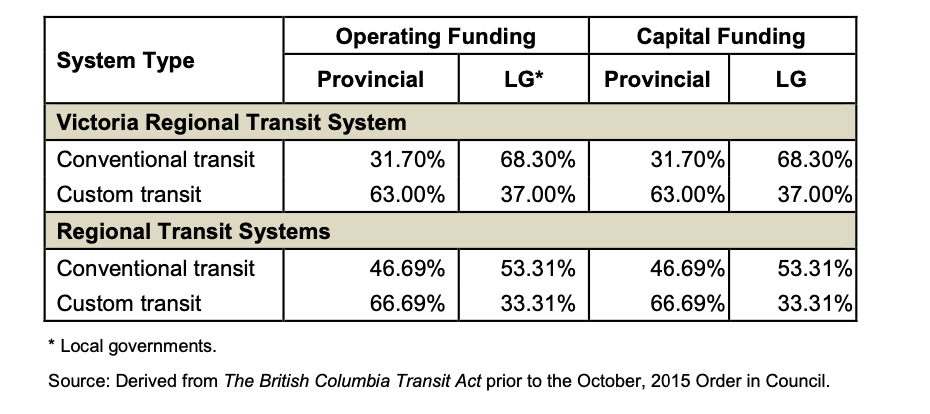
The local share mostly consists of property taxes and fares. In Victoria, the transit commission also receives revenue from a regional gas tax, which has been steadily declining due to EV adoption.
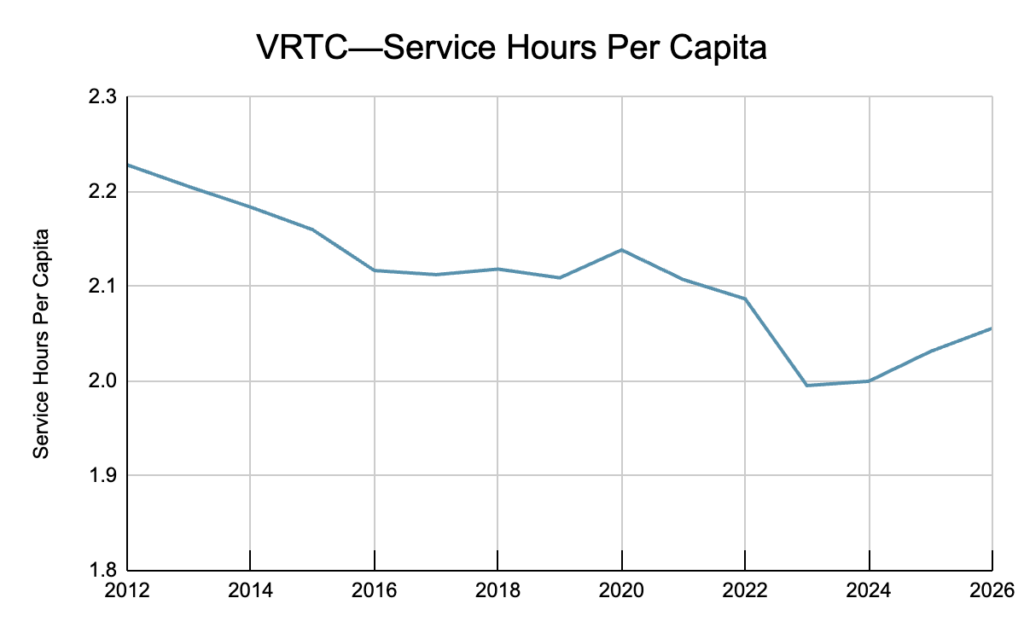
The Province essentially dictates yearly maximum expansion as part of the yearly budget process. There is no certainty year to year over transit expansion, and it has largely fallen behind population growth.
The split applies to both operational and capital funding. This essentially means that no capital expenditure can be approved without the province and regions agreeing.
One tricky part of expansion is that BC Transit plans its schedules January - December, but gets funded April - March. That means that expansion always comes in two pieces, with expansion levels for a given year set by the expectations from the previous budget.

As a concrete example, BC Transit was funded for January 2026 to April 2026 out of Budget 2025. This included the expected expansion to account for the assumed service levels that BC Transit expected would be funded under Budget 2026.

This means that when the expected funding didn’t come through, the province cut service in multiple regions even if the overall level of funding stayed flat year to year.

This delay also means that service planning comes with a significant delay, as BC Transit doesn't know how much expansion they will get for the rest of the year until Budget Day in February or March.
The BC Liberals repealed the regulated funding split in 2015 for most of the province, and theoretically replaced it with a system of negotiated agreements. While reportedly the funding split is still quite similar, there is a lack of transparency in how this funding is allocated, as the Province doesn’t publish the Annual Operational Agreements between BC Transit and regions.
In theory, the removal of the regulation should allow municipalities and regions to negotiate for unique funding splits, or independently fund expansion. BC Transit staff indicate that the 47% split is still in effect as it was a decade ago, regardless of the regulation. Unfortunately, this is extremely hard to verify.
While the split ensures long-term stability, it creates a chicken-and-egg problem, where both the province and local governments need to agree to expand transit service. With increasing vehicle congestion and lower speed limits across much of the province, this has kept public transit relatively stagnant outside of Metro Vancouver, especially in Victoria. The year to year negotiations also mean that it is extremely difficult to strategically expand or develop system services; for example most of Victoria’s funding for the last decade has gone to maintaining service levels in the face of increasing congestion.
The way capital expenditure functions for BC Transit and BC Ferries also shows the advantages that the Province gives to motorist infrastructure. While highway infrastructure is paid for out of the public purse, BC Transit is required to take on debt, which local partners and the province pay down together. BC Ferries has to rely on fares (and limited provincial and federal subsidies) to pay for capital investments.
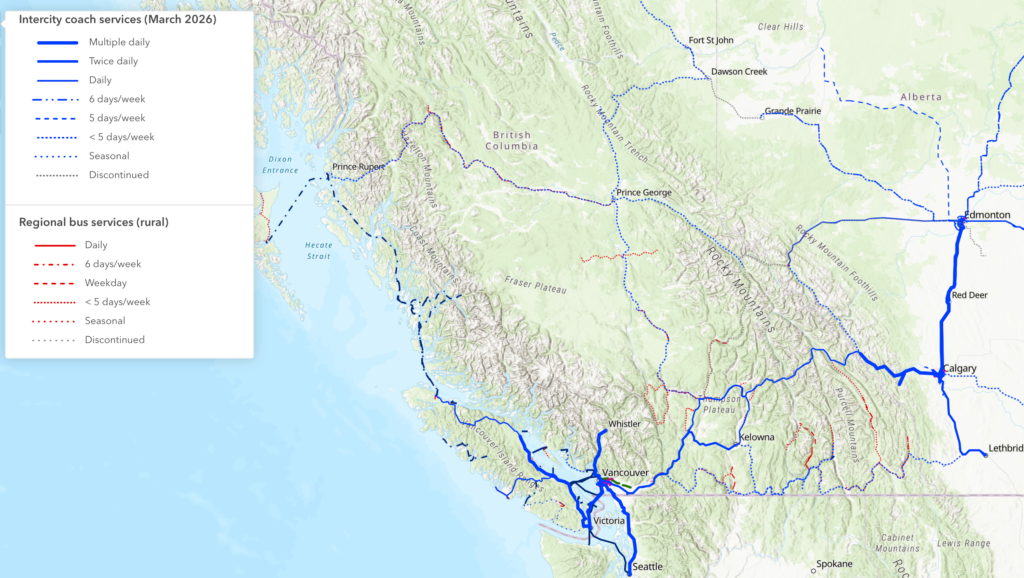
The funding split for BC Transit also makes it difficult to operate cross-regional or interregional transit. Remember, the Province never meant for BC Transit to operate interregional transit— that was the purview of Pacific Coach Lines in the 1970s split. Currently, new interregional routes require consensus between the province, each relevant transit region, and BC Transit for funding and operation.
The tight regulation of the private market (which will have to be discussed another time) makes it difficult for new companies to try intercity busses. The classic Island example is that private bus companies have a high barrier to operate between Victoria and Duncan, because of the theoretical existence of a public option (BC Transit operates a small number of trips, into Victoria in the morning and back to Duncan in the evening).
Subsidies for car owners have also continued to burden local and provincial purses. Under the BC Liberals and BCNDP, the Province steadily cut tolls from every Fraser River bridge, putting the cost of debt and maintenance directly on TransLink and the Province.
In 2017, the newly elected BCNDP voted to end tolls on the Golden Ears bridge. In exchange they provided $2 billion to TransLink to make up for lost funding through 2050. The BCNDP have kept the lion’s share of capital investment for highway expansion and replacement and have not introduced any tolls to pay for new bridges, instead paying for replacements from general revenue.
One bright piece is the shift towards provincial funding of major transit infrastructure projects. While historically SkyTrain and similar projects were funded 33/33/33 (local/provincial/federal) the Broadway and Surrey-Langley SkyTrain projects are funded mostly through the province, with the federal government still picking up their piece. This represents a significant and positive shift towards provincial support for transit.
This all leaves us with the system we have today. Across the whole province, transit rarely works well across jurisdictional borders. For most of the province, an unclear and opaque funding system dependent on year to year negotiations for transit expansion and investment. For Metro Vancouver, an underfunded system that operates bailout to bailout (or major cut to major cut). Unless we fix the issues of unequal subsidy for transit and highways, build a new funding model, and learn how to build new transit institutions, transit won’t scale.
What next?
I can’t leave this article on such a low note. BC has a pretty strong public transit system in it’s major cities, for North America. We have a robust funding model that has stayed strong throughout years of austerity. We have a strong base to build from.
How do we scale transit? You’ll have to wait for the second article in this series.

Leave a Reply