
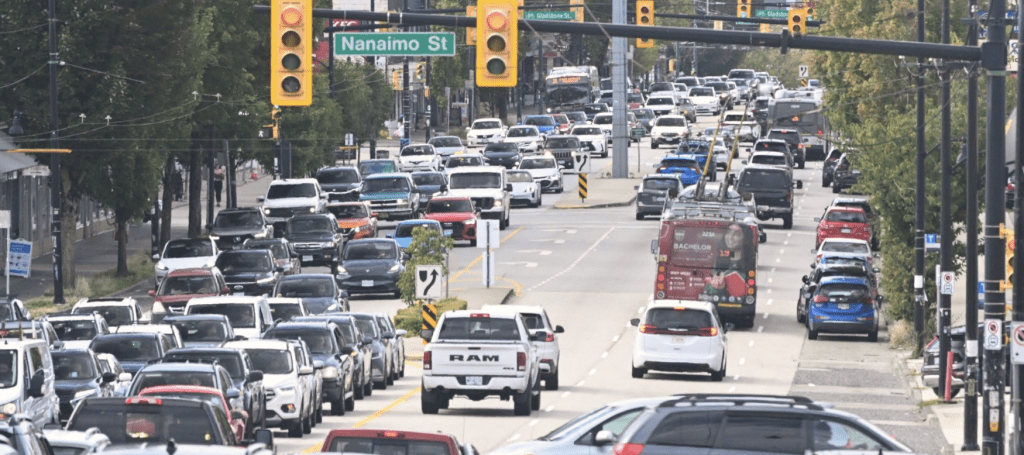
TransLink and the City of Vancouver are proposing transit priority measures and bus stop balancing along Kingsway, focusing on Route 19. And it’s a great place to start! The 19 is the 9th most used bus route in the entire region1, while also being the 4th slowest1, which means improvements that are made here will have an outsized benefit not just to the 19 itself, but to the broader network as well through the network effect.
The current proposals are available on the City of Vancouver’s website.
As proposed, however, it simply doesn’t go far enough. Despite Council motions passed in 2023 and 2024 to implement transit priority with a goal of a 10% savings2, these changes are only projected to save 3%3, or about 2 minutes on an entire one-way 19 trip, end to end. Two minutes, that on a trip in the PM peak, can take over 80 minutes! This is negligible – and if I were the scheduler tasked with adjusting the schedule for this, I would not even be changing the schedules. This is, at best, enough of a savings for me to consider de-prioritizing it for schedule maintenance (adjustments due to natural decreases in transit speed due to factors including but not limited to traffic growth and ridership growth) for a year.
So, what can they do instead? Well, LOTS.
Movement: Metro Vancouver Transit Riders had recently submitted a FOI request to TransLink, and received historic bus speed and variability data from Fall 2024, which they were kind enough to share with me. I will primarily be referring to that data below – as there’s nothing better than actual transit data.
As a quick aside, the project area only commences at the intersection of Main St and Union St, and does not continue further into Downtown. The Downtown section probably does require a separate project, with more aggressive intervention, to properly address, of course, but I am a bit disappointed nevertheless that no proposals have come into the public view, despite the sheer number of bus routes flowing through Chinatown and into Downtown.
I’m not an engineer or infrastructure planner by any means, so I’m not here to provide alternative solutions (we have some brilliant engineers and planners that I’m sure will be able to cook up something far better than anything I can dream up), but I am familiar enough with runtime variability to be able to make an educated guess how the proposals will impact transit operations. There are a few areas that I would like to highlight.
Along Main St between Union St and 7th Ave, the City is proposing to extend the existing 7-to-7 daily bus lanes for this whole section.

This is a fantastic addition, especially when noting that this provides some much-needed transit priority for those off-peak and weekend periods where we’re starting to see an increasing trend with congestion. In particular, the northbound segment approaching Union St sees a fairly consistent pattern of slowdowns all throughout the day every day of week, which this proposal will certainly help support.
That said, I do feel that there are opportunities within this segment to do better. In particular, while this proposal is great for north-south transit movement along this section generally, does this really meaningfully improve transit movements at The Worst Intersection in Metro Vancouver™? (For the uninitiated, that’s the Main / Kingsway / 7th intersection)4.
Here’s what the data says:

Since this is the first excerpt I’m including, a quick explainer: This documents Weekday stop-to-stop data for the eastbound Route 19 between Main St & E 5 Ave and Kingsway & Main St, separated out by hour of day, and detailed with the 20th-percentile, median, average, and 80th-percentile runtimes.
At the intersection of Main / Kingsway / 7th, the eastbound 19 (and the 8 as well – the 5th slowest bus route in the region)1 needs to make the left turn movement from southbound Main onto eastbound Kingsway. After servicing the stop at 5th Ave, the 19 must change lanes into the outer left-turn lane and wait for a dedicated signal phase.

A curbside bus lane is clearly not going to do much if anything to help the 19 at all at this location – and it’s worth noting that this section already has a curbside bus lane – and so the City is not proposing any changes to this location at all.
Now, let’s return to the data. There are a few items to note specifically:
- Throughout the day, the average value sits above the median value. This suggests the presence of a significant amount of outliers on the high (i.e. bad/slow) side that is skewing the results.
- In the PM peak in particular, the 80th-percentile value increases by up to a whole minute, and the gap between the median and average values also grows significantly. This suggests a much higher likelihood that a bus waiting to turn left here would be stuck for not just one, but likely multiple cycles.
In transit scheduling, if you want to ensure a reliable service, you would be building your schedules to that worst-case scenario, if not in scheduled runtime, in the recovery after the trip. Ever experienced waiting at a timing point for several minutes and wished the concept of timing points didn’t exist? That is very likely because of the extreme variability that we see on many segments. I can write a whole other wall of text on why timing points deserve your love rather than your hate, but I digress.
Anyhow. Remember that projected savings of about 2 minutes end to end? If instead of doing nothing to The Worst Intersection in Metro Vancouver™, the City found a way to meaningfully improve that left turn so that the 8 and 19 aren’t stuck for multiple cycles in the PM peak, that alone will shave off a minute on your worst case scenario / delay. In other words, intervening in this intersection alone will generate almost half the savings the current proposals are projected to save for the entire corridor.
Similar left turn delays are evident for, well, everywhere we have a bus turning left. The 8’s additional left turn to get onto eastbound Broadway after the above is a problem spot. The 25’s left from Kingsway onto Nanaimo is also awful for delay and variability. I’ll come back to this one shortly.
Speaking of the 25, that leads me to the next segment that I’d really like to highlight – the section between Dumfries St and Nanaimo St, where both the 19 and 25 share the Kingsway corridor.

This is the only section on Kingsway where the City is proposing bus lanes for both peaks, both ways. What gives? Is there something specifically bad about this section, worse than every other stretch of Kingsway?

TransLink’s Bus Speed and Reliability report5 does cite this section as significantly worse than the rest of Kingsway, but is this really telling the whole story?
A quick glimpse at the Fall 2024 actual runtime data suggests that while there are bad pockets within this segment, overall this section isn’t significantly worse than other areas. What gives?
The key distinction here is that TransLink is measuring delay in person-hours. I personally really quite like this measure, but it has its limitations and needs to be taken in context. Person-hours of delay per km as a measure does a fantastic job at normalizing how much transit riders are being impacted by delays, by incorporating ridership in a meaningful way. The more riders are affected by delays, the higher that number will be. It’s a great measure to look at if you want to prioritize where to help the most people with a project.
The downside to this, however, is that it can make service levels trump severity of the delays, as has happened for this stretch of Kingsway. This section is much worse in people-hours of delay, but that’s largely because you have much more service, and consequently much higher ridership, along this section, because the 25 is also in the mix, rather than just the 19 alone. Looking at it positively, it means we’re prioritizing our resources where we can benefit the most people, but looking at it another way, it means we’re likely watering down our interventions to areas that really need it, solely because the ridership and service levels are lower (and thus the problem looks less severe), even though there may very well be cases where the unreliability of the service is artificially depressing ridership and service levels.
Anyway, going back to this specific section.

The pockets of red are areas where the designated bus lanes end and become a bus + right turn lane. The most apparent one here is at Kingsway and Victoria. Let’s see what the transit data suggests for this section.

Currently, peak-directional no-parking restrictions are already in effect. So for this westbound segment, the curb lane is already a no-stopping zone 7AM to 6PM daily. We can see that despite this, the worst delays of the entire service day for this specific segment (westbound approaching Victoria) is during that AM peak period. If you compared this to the City’s proposals, this is another case where no improvements are being proposed, as the current state already matches that.
This example is also a great reminder that while curbside bus lanes are great, they do not interact well with right-turning traffic at all. The reason the proposed bus lanes end where they do is specifically because of right-turning traffic, as they would be queued up in the curb lane regardless anyway. TransLink also notes this shortfall in their Bus Speed and Reliability Report, using an example from Edmonds St in Burnaby6:

The Kingsway and Victoria intersection is just another location where identifying some sort of intervention to protect buses from delays caused by right-turning traffic can have an outsized impact, but where the City is proposing no intervention.
Another location within this section worth highlighting is the intersection of Kingsway and Nanaimo St, where the eastbound 25 must turn left onto northbound Nanaimo.

This is another location where left-turn delays are especially apparent at almost all times of day. For almost the entirety of the daytime period, the services experiences a full minute of variability between the 20th– and 80th-percentile values, indicating an extremely high likelihood that the bus is often being delayed a full signal cycle, even during off-peak hours. The increase in the PM peak is especially noticeable, even in the 20th– and median numbers, which suggests that during those times, instead of a likelihood that the bus is stuck for a full cycle, it’s almost guaranteed that the bus will get stuck at this location for at least one, if not multiple cycles.
And yet again – the only intervention that the City is proposing at this location eastbound is…. Extending the existing curb lane parking restriction to cover the AM peak as well. This is very clearly not going to do anything to help the 25, even though addressing this single turn movement alone can shave off up to 2 minutes for the eastbound 25.
There is another point that I’d like to highlight, using the section between Joyce and Boundary as an example.

Along this section (as with the majority of Kingsway), the City is only proposing to modify the existing peak-direction parking restrictions to turn it from a general lane into a bus lane instead.

The data simply does not jive with the proposals. Yes, the AM peak has that third lane westbound already, and that likely explains why the numbers are lower, but it’s also clearly evident that delays along this section build up throughout the day and max out in the PM peak – a period where no interventions are being proposed.
This is a common trend for almost all of westbound Kingsway – the delays gradually build through the course of the midday, and max out in the PM peak. On Weekends, that’s usually during the midday and afternoon hours as well. An AM-peak-only bus lane implementation misses the worst of the problems, and isn’t likely to generate much in the way of savings. PM peak delays are especially significant, likely due to the need to merge in and out of traffic at every stop, as every stop becomes a pull-out stop due to the parking lane.
So, what’s the takeaway?
I think there are a number of issues at play:
- Planners, Engineers, and Schedulers continue to be married to the assumption of peak directionality and pre-COVID norms
- The right interventions are not being applied to the right places/times
- The allure of bus lanes can sometimes overshadow other effective tools within the transit priority toolkit
First, the peak directionality problem. The COVID-19 pandemic has permanently shifted our travel patterns. Yes, the AM peak is gradually returning as more and more workplaces are mandating a full return to office, but the changes and increases in demand, during off-peak hours and weekends especially, have stayed and are stronger than ever. Gone are the days of “the AM peak has the worst delays”. “Weekday > Saturday > Sunday” is an outdated adage from a bygone era. Travel patterns have changed, but transit planning best practices are slow to follow.
On a majority of Kingsway, for example, the AM peak is actually one of the least delayed periods during the day (though with the caveat that the existing parking restrictions likely contribute to that). There’s likely an element of desire to make the most minimal intervention possible given the existing state, but AM peak bus lanes westbound simply aren’t going to do much if anything to speed up the 19, and the real opportunities are through the midday and PM peak.
There most definitely are areas where an AM peak treatment isn’t just helpful, but actually critically needed (every bridge inbound, for example), but that does not mean we can just assume that targeting the AM peak on an inbound segment will hit the worst of the issue, because that is just not true. We need to be more critical in identifying those time frames, and better tailor our interventions to actual conditions on the road.
This project, as proposed, does not do a very good job at achieving that. There’s a reason that these changes are only expected to yield a rounding error in savings – it does not make any effective (or often, any at all) intervention at the worst problem spots for delay. Intersection related delays, whether it be for turning movements that the bus needs to make, having to wait for a signal cycle, or conflicts with turning vehicles, are among the worst offenders for transit delay.
As proposed however, most of the interventions are going towards extending bus lanes through mid-block segments (often at the wrong times, mind you). That implementation has an outsized effectiveness when targeting general gridlock, especially for extended periods of time. The proposals, however, completely ignore the intersections, where the worst delays are happening on Kingsway. I don’t know why the intersections aren’t being looked at more critically, but you are simply not achieving a 10% time savings without addressing those problem intersections.
As an extension to this, I feel that while bus lanes can be incredibly effective at addressing transit delays, there can also be times when the allure of bus lanes can make one overlook all the various other tools in the transit priority toolkit.
Don’t get me wrong – I love my bus lanes. My Halloween costume was literally a buƨ lane.
Bus lanes are one of the more aggressive transit priority interventions possible, and usually deliver some of the best results for speed and reliability as well. However, they are unfortunately not perfect, and each form of a bus lane has their own drawbacks, that if not properly planned around, could actually yield a net negative. There’s the Edmonds St example6 earlier, where conflicts with right-turning traffic have slowed things down during certain times of day. There’s also the Pie-IX BRT in Montreal, with full median-running bus lanes, where a lack of proper signal priority has actually slowed the service down, when compared to the express bus it had replaced.7
There can even be cases where bus lanes may not even be your most effective tool towards addressing transit delays. Any sort of signal related intervention, for example, will have a greater impact at addressing those left-turn delays, compared to a curbside bus lane that a left-turning bus is not going to be using. A peak-only bus lane also does nothing to address off-peak and weekend delays associated with pulling out from a bus stop, out of the parking lane, and back into traffic.
Bus lanes are one of the most effective tools available in the transit priority toolkit, but they are not omnipotent. Bus lanes are like a hammer – they’re aggressive, and when used in the right places, are incredibly effective at achieving the results you’re looking for. What they are not though, are Swiss army knives. If the goal is to maximize the impact towards improving bus speed and reliability, we have to remember about all of the other tools available in our toolkit as well – signal priority, bus bulbs, stop balancing, to name a few – and be much more critical and targeted in assessing where each tool could be the best solution at delivering the best results for transit riders.
Unfortunately, I had hoped to get this article up and posted while the City’s survey was still open, but technical difficulties have prevented that. Instead, I had submitted my feedback to the City at kingswaybuspriority@vancouver.ca, and I would encourage everyone to do the same, if you haven’t already.
Also consider joining the conversation with Movement: Metro Vancouver Transit Riders.
For such a regionally important route, the 19 should not be the 4th slowest in the region – and there is so much more that can be done to make sure that’s not the case.
- 2024 Transit Service Performance Review, TransLink.
- Advancing Rapid Transit and Priority RapidBus Upgrade Projects in Vancouver to Support Complete Communities, Livability and Growth. City of Vancouver Council Motion, November 2023.
- Dream of a Better 19. Movement: Metro Vancouver Transit Riders.
- Main & 7th is the worst intersection in Metro Vancouver. Vision Zero Vancouver.
- Appendix B, 2023 Bus Speed and Reliability Report, TransLink.
- Part 4, 2023 Bus Speed and Reliability Report, TransLink.
- $600 million later, the Pie-IX BRT is not faster than the old express. Radio-Canada.

Leave a Reply