
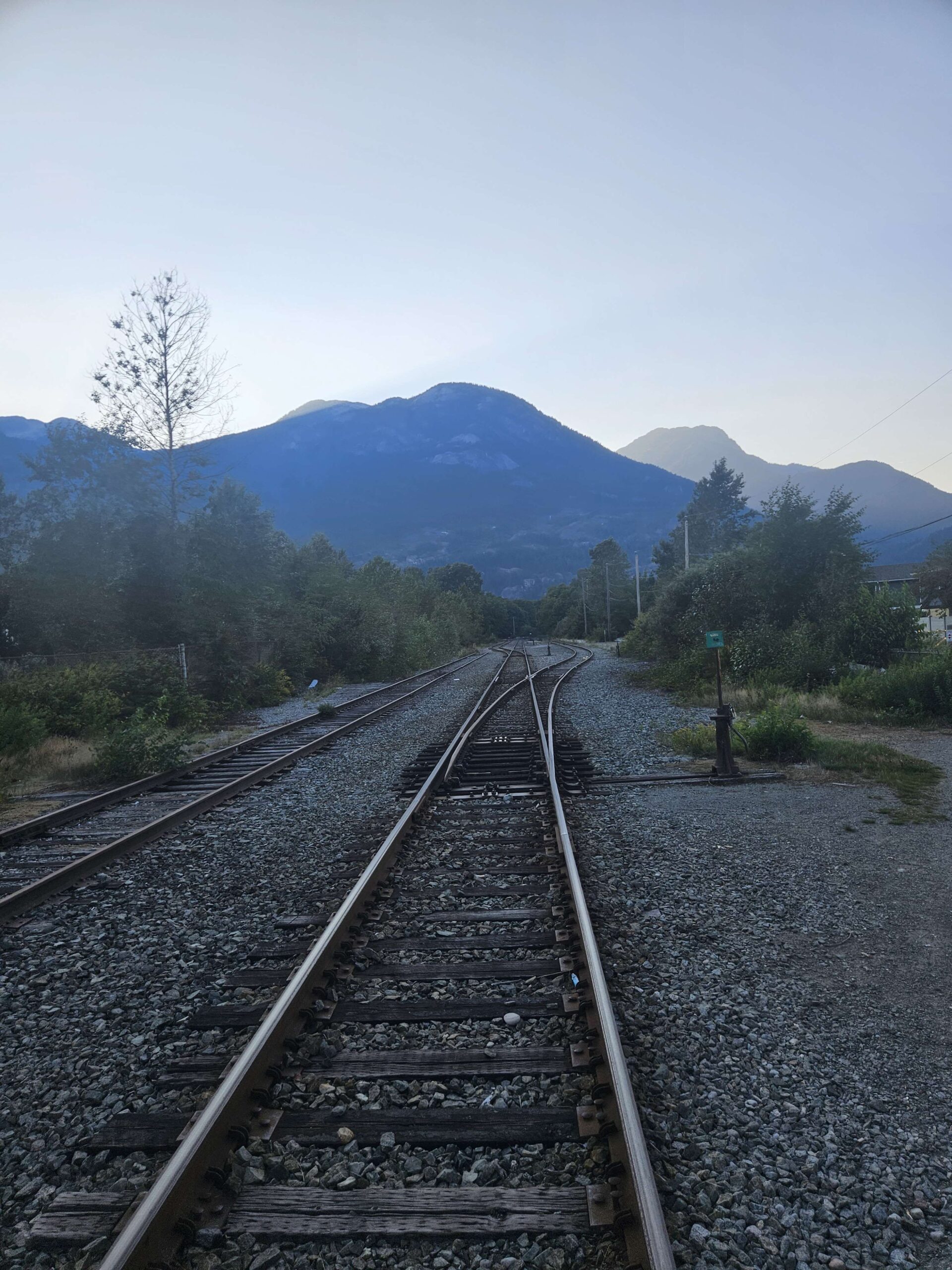
Trains are cool. It’s worth reiterating, however, why trains are so amazing – they are the most efficient way to transport stuff on land per unit of distance and of cargo mass. They cost less, emit far less carbon, can typically move faster, and use less land than competing modes. For passengers, they offer a smoother and more comfortable experience than driving or taking a bus. For companies looking to ship goods, it’s much easier to move lots of cargo a long way. These are important and unavoidable reasons for which a good railroad network is crucial to any modern transportation system.
We also now live in an age of renewed interest in longer-distance rail. The Carney government has made rail one of its flagship policies with the Alto high-speed rail project, Ontario’s GO modernization plans have continued apace, and even famously conservative Alberta has put forth ambitious intercity rail plans. British Columbians may naturally wonder “what about us?”. Vancouver is, after all, above everything else a child of the Canadian Pacific Railroad – trains are a crucial piece of our history, as they are for the entire Canadian project. Polling indeed suggests that rail has very high support in BC. Unfortunately, bolstering our legacy rail system with renewed vitality, both provincially and nationwide, is far easier said than done.
Where things derail
The most fundamental problem for Canadian rail installation is one of geography. It’s hard to imagine a more rail-hostile piece of land than BC; Hundreds of kilometres of sparsely populated mountains separate our province’s big population centres. For the cities that don’t have mountains between them, there is instead a strait that would only require the world’s longest rail tunnel to cross. Besides Vancouver, the nearest truly big cities are either Calgary, which is nearly a thousand kilometres away across all of those mountains, and Seattle, which is a far more reasonable 230 kilometres away but across an international border.
In this kind of terrain and these kinds of distances, the speed and cost advantages of rail compared to road vehicles shrinks tremendously without major modernization efforts. Under these circumstances, taxpayers or investors need to be very sure that building something as expensive and technically demanding as a new railroad would be worth their money and energy in order to support such a project.
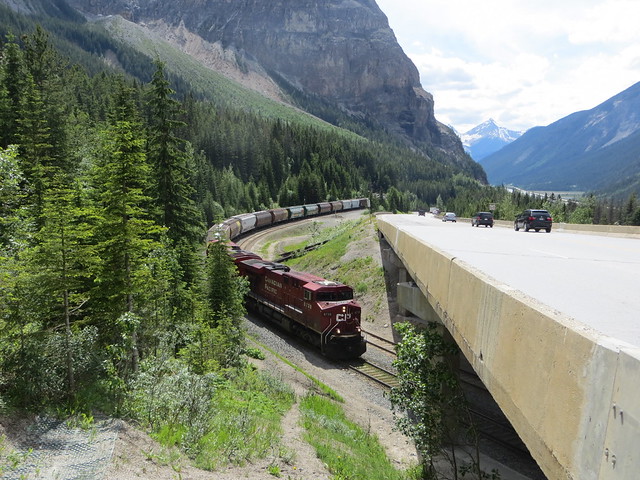
A Canadian Pacific freight train braves the trip through Kicking Horse Pass. Photo credit: David Wilson under Creative Commons License 2.0
How about the legacy rail infrastructure we’ve inherited from our predecessors? It’s hard to say that in its current state it lives up to the task. By and large it was built in the 19th and early 20th centuries and has never been upgraded from its old Victorian standards.
Our railways are slow, low capacity, unelectrified, and technically inefficient. Crucial bottlenecks like the crossings of the Fraser River at New Westminster and Mission still rely on positively ancient single-tracked bridges, built in 1904 and 1909 respectively. Amtrak Cascade trains arriving at Pacific Central Station still need conductors to physically get out of the train and manually throw switches to get through the CN rail yard. The primary rail approaches to Vancouver are either the winding CPKC mainline along the coast of Burrard Inlet or up the single-tracked Grandview Cut.
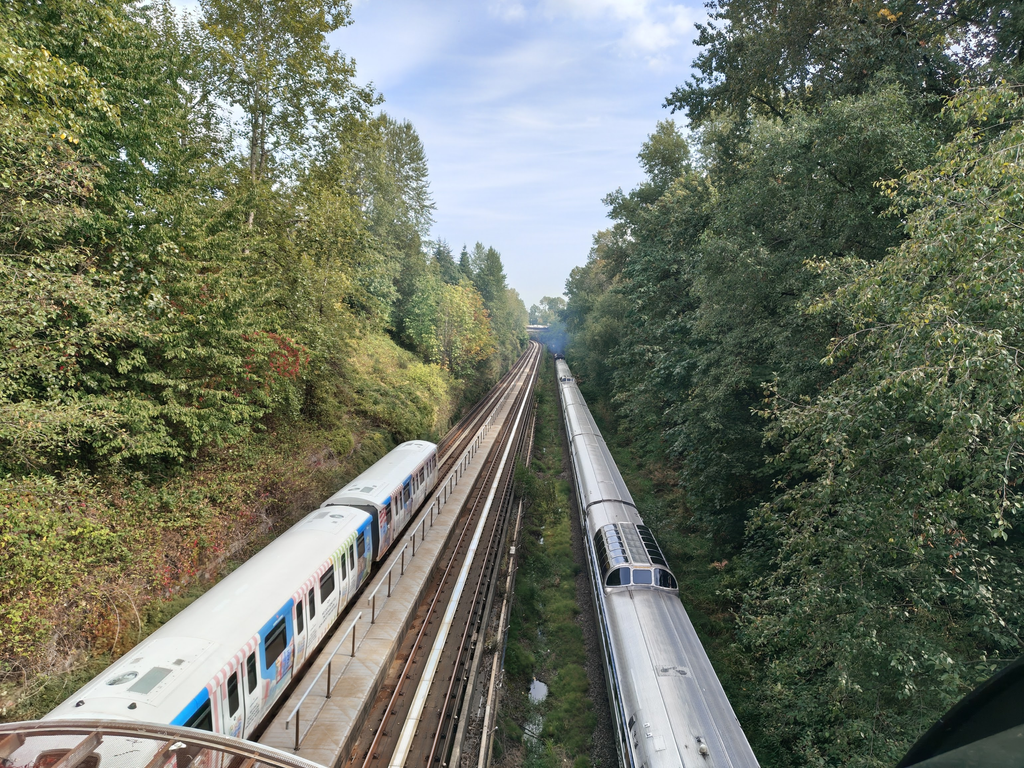
Especially with the the Millennium Line, the Grandview Cut is a real tight squeeze. Photo taken by Abby Ivison.
Things are even sparser outside of the Lower Mainland. Kelowna no longer has any railway at all. The one extant rail corridor on Vancouver Island between Esquimalt and Nanaimo has been sitting unused for so long that local First Nations have naturally started to think of better things that they could be using their land for. The port at Prince Rupert means that CN’s line across the North will continue to live on, but other rural rail corridors like the old BC Rail line between Vancouver and Prince George via Squamish and Lilooet are in real danger of complete abandonment.
Aside from Amtrak’s fairly well-used twice daily Cascades service to Seattle and Portland, VIA’s Canadian bound for Toronto and Prince Rupert-Jasper services are token tourist lines that run less than once a day. Freight services do somewhat better because of a lack of realistic alternatives, but the same problems impose major constraints on the movement of freight in and out of two of Canada’s busiest ports.
Why do these conditions persist? A major reason is the business model of the two private freight railroads who own virtually all of our tracks: the Canadian Pacific Kansas City Railroad (CPKC) and Canadian National Railroad (CNR). North American freight railroads rely on transporting as much as they can at once for as little cost as possible, a business model somewhat ironically known as “precision scheduled railroading”. This means running very infrequent, long trains in order for each locomotive to carry its maximum possible tonnage of goods, which minimizes upfront investment in infrastructure.
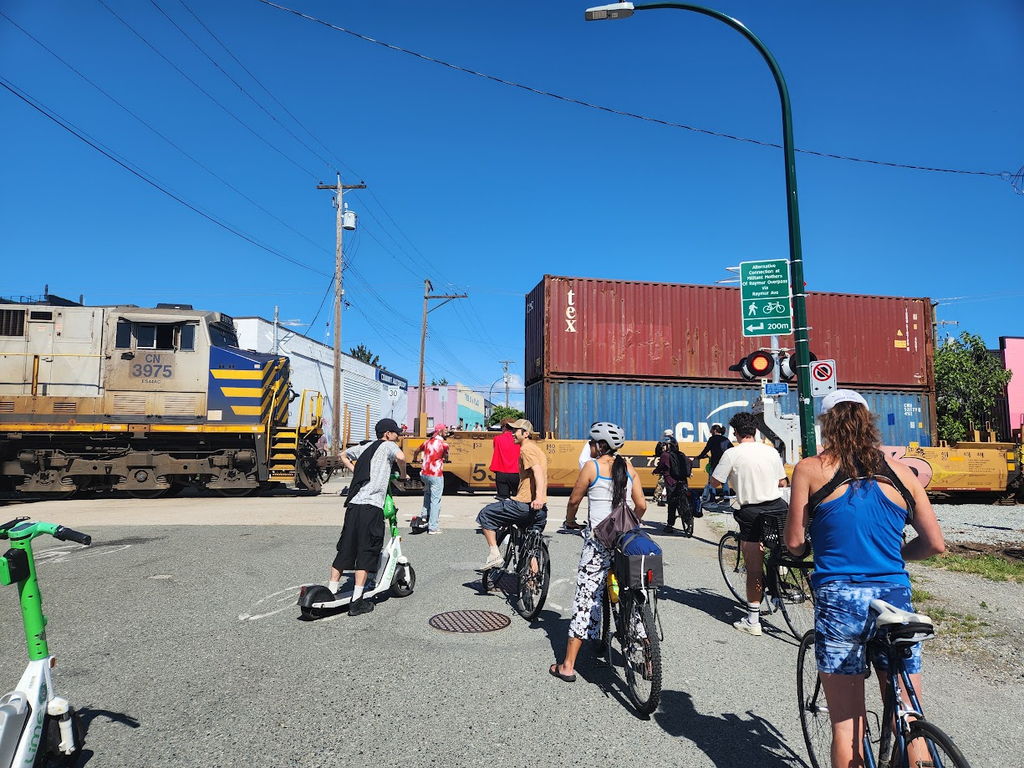
Long trains make long delays. Photo credit: Mark Edwardson
Since a shipping container doesn’t care about how fast it’s going or what time it gets to its destination in the same way a traveling human does, all that matters is that it gets to its contractual destination at roughly the right time. It therefore behooves these railroads to run their trains at fairly slow speeds to save on energy costs, and to keep a fairly loose schedule to flexibly meet the demands of their clients.
This is not compatible with passenger service, which requires fast, frequent, and reliably-scheduled trains in order to be useful. It takes a lot of money to build new lines or to make upgrades to existing ones like double-tracking or electrification, so given the need to ensure steady profits for shareholders, freight companies typically won’t do so unless it’s strictly necessary.
The Light at the End of the Tunnel
For passenger service to be worth anyone’s time it needs to allow for reliably competitive trip times. This means speed but also frequency and reliability. For this to be possible it would take infrastructure that simply does not yet exist, alongside changes to how the freight railroads operate.
Both of these would take investments of financial and political capital that given population distribution and terrain may be very hard to raise as things currently stand. Advocates and policymakers should be aware of this and calibrate their expectations accordingly. In the medium term, intercity and interregional buses are by far the more effective way to get better long-range service in this province.
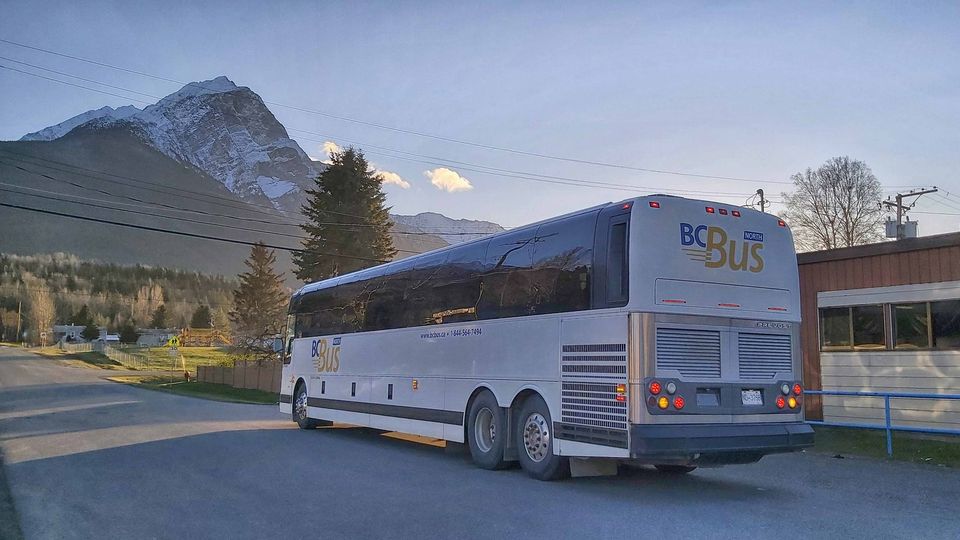
An expansion of intercity bus service could be transformative for comparatively tiny amounts of money. Image credit: Prince George Citizen
This doesn’t mean we should despair, though. Just because something is difficult doesn’t mean it’s impossible. The vast, mountainous expanses that bring people from the world over to BC make rail a challenging proposition, but famously mountainous countries like Japan, Switzerland, and South Korea have been able to make do anyway. If we learn from their example, we may be able to make lemonade out of the lemons we’ve been given.
Fully modernizing rail in BC is a daunting task, but it doesn’t mean we need to do everything at once. None of the above constraints apply to the SkyTrain in Metro Vancouver, whose completely independent urban rail system faces relatively few limits on its expansion. We could start with some more moderate goals, like upgrading the West Coast Express to all-day two-way service or extending it to Abbotsford across a new Mission bridge, establishing an effective Westshore rail service in Victoria as my friend Sam Holland has suggested.
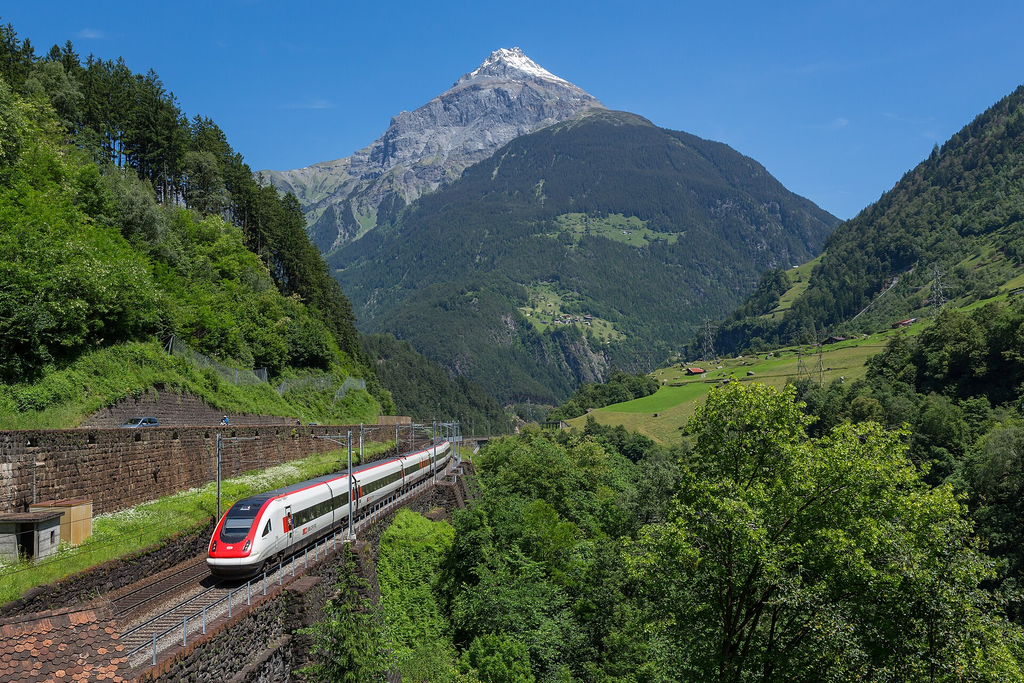
If the Swiss can make it work, why not us? Photo credit: David Gubler under Creative Commons License 4.0
The restoration of rail service to places like Squamish or Nanaimo aren’t outside the realm of possibility, but they would need to be built to modern standards that would require substantial upgrades to compete with driving – nostalgia is not a plan. Greater ambitions like a train between Vancouver and Kelowna or true high-speed rail to Seattle are worth pursuing, but the conditions to create those are likely a long way off.
In the meantime, we need practice and we need ambition. We need to build up our technical knowledge and procurement processes, and we will likely need to come to agreements with the private railways or even bring the railways into the public realm to fully integrate them with reliable passenger rail service. We need to understand that while a more rail-based future may be rather distant yet, investments in programs like an intercity bus service of the kind advocated for by the Public Transit Alliance of BC or incremental improvements to services like the West Coast Express could be accomplished much quicker to get things started. Above all, to bring modernized mainline rail to this province, we need to believe that we can do things just as well as people elsewhere, if we tried.

Leave a Reply